
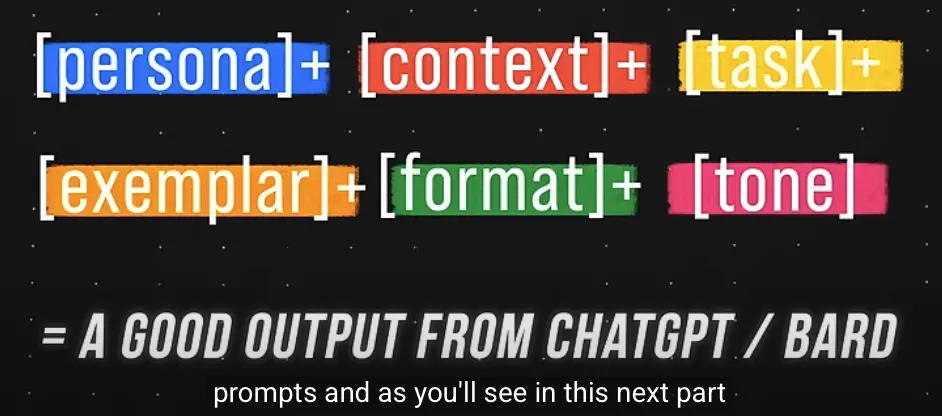
This guide explores the essential components needed to craft high-quality prompts for AI systems. It breaks down each element – Character, Context, Task, Exemplar, Format and Tone – explaining their definitions, purposes and providing practical examples. You’ll learn the recommended order for assembling these components to maximize clarity and efficiency, whether you’re generating content, planning trips, or building reusable templates. By following this structure, you can ensure that your AI interactions are accurate, consistent, and tailored to your needs.
Definition: The emotional or stylistic quality of the language used in the response.
Objective: corresponds to the writing’s expectations of the target audience or the voice of the brand.
Examples:
When constructing a prompt, the order of these components can have a significant impact on the clarity and effectiveness of the AI’s response. While flexibility is important, adhering to a logical sequence helps ensure that all necessary information is conveyed. The preferred order of these components when making a high quality prompt is:
Start by defining who the IA should be - this defines the voice, expertise and perspective. *Why first? * It immediately aligns response style and role.
Next, provide background or situational information relevant to the request. *Why second? * It frames the scenario for the AI to make informed decisions.
Next, clearly state what you want the AI to do. * Why third? * Once the AI knows who it is and the situation, it can focus on the objective.
Specify how the output should be structured (e.g. table, bullets, HTML). * Why fourth? * This shapes the deliverable to meet your needs.
Define the style or emotional quality of the language. * Why fifth? * This refines the mood or formality of the response.
Finally, provide samples to illustrate expectations. * Why last? * Examples clarify everything above - ideal as reinforcement or disambiguation.
| # | Component | Purpose |
|---|---|---|
| 1 | Persona | Who speaks |
| 2 | Context | What is the situation |
| 3 | Task | What to do |
| 4 | Format | How to structure it |
| 5 | ton | What feeling or style |
| 6 | copy | Show model output (optional but useful) |
Persona: [Describe the role, expertise, or character of the AI]

Background: [Provide background, scenario or relevant details]

Task: [Clearly indicate the action or output you want]

Format: [Specify the desired output structure, e.g. table, list, JSON]

Tone: [Indicate style or emotional quality, e.g., friendly, professional]

Example:
    Entry: [Sample entry]
    Output: [Sample output]
Subscribe for travel planning updates.