
This project is developed by the Engineering Laboratory for Sustainable Development LIDD. Ms. Lucie Richard-Duclos carried out part of her master’s project on the design and distribution of the Low tech stove for people experiencing homelessness.
Within LIDD, projects focus on Low Tech and Appropriate Technologies for development aid in partnership with NGOs (Oxfam, ISF, CUSO, CREDIL)
More recently, the needs have been felt here in our rich countries. Within the LIDD we therefore proposed to think about solutions to help people experiencing homelessness. Not being experts on the subject of homelessness, we surrounded ourselves with organizations that work with the most vulnerable such as RAPSIM, Dans la Rue, Le Cap St Barnabé, L’Anonyme. … Hence our presence at the Night of the Homeless, for a Low Tech Workshop.
Based on several meetings and discussions, we analyzed the problems (the cold for example), the needs (heating, cooking your meal), the obstacles (regulations on open fires, access to knowledge, access to materials), the levers (the Low tech approach is one)….
From there was born our small Low Tech stove made exclusively with materials: Intended for recycling (Circular economy - cans) Easily available in the street (The collective kitchen of Cap St Barnabé has hundreds of them every month) Easy to implement without, or with few, tools…
An object was needed that was simple to make, to duplicate, to use, to transport, to repair….
We invented almost nothing… We adapted to the context, developed and modeled a prototype, tested, measured performance, adapted manufacturing.
We added thermal storage based on 3⁄4 rocks (a bit like a heater) so that users can warm their hands, even when the fire is extinguished after use.
This allows the stove to be turned off, but hot, into the ‘camper’s’ tent without risk of fire or carbon monoxide poisoning.
At the same time we comply with the regulations: It is not an open fire and the system does not have a propane tank. We burn wood, cardboard, newspaper… whatever is available on the street. No explosive fossil fuel.
So we kill several birds with one stone:
-Heating water, food -Warming of hands, feet -Risk reduction (fire, poisoning) -Improvement of people’s autonomy
Of course you can pass everything around. Everything is free of rights. The idea is to help as many people as possible.
I find this project very interesting for camping enthusiasts. Very interesting solution at an affordable cost. Since this project is primarily developed for people experiencing homelessness, I suggest that you print several copies and distribute them when you meet a homeless person during your travels. Our travels shape our view of the world. We can improve it so why hesitate.
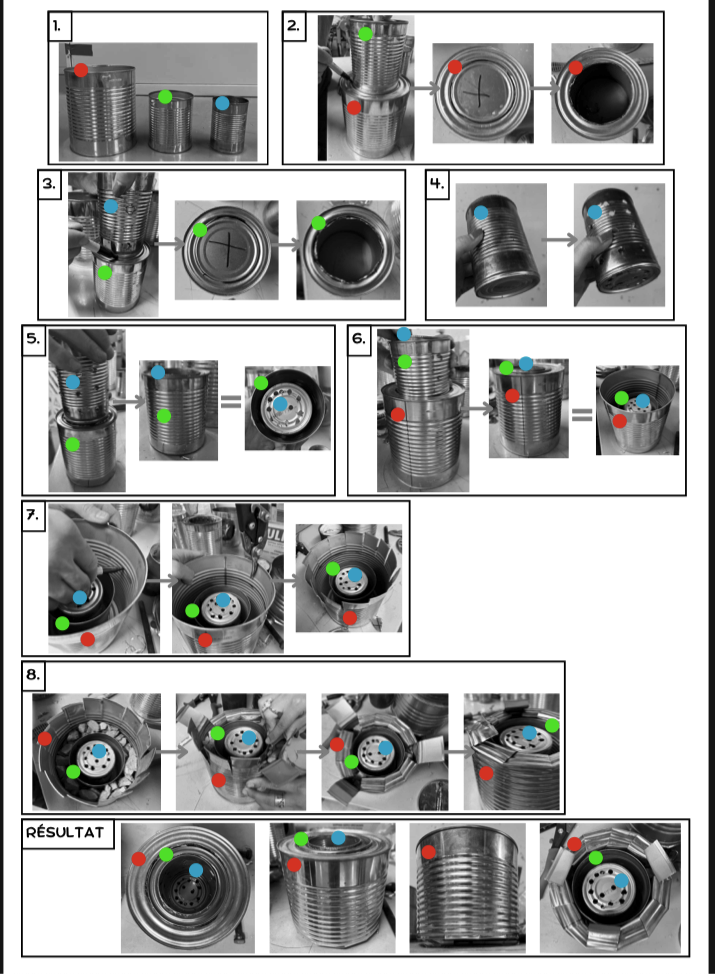
The manufacturing instructions are quite “simple”, almost without text, because they must be accessible to everyone, without constraints, regardless of the language spoken.
Subscribe for travel planning updates.